

How to Understand Japanese Humor in English

A joke can get a huge laugh in Osaka, followed by a moment where an English-speaking visitor wonders: Wait, what just happened? If you want to understand Japanese humor in English, the answer is rarely a direct translation. It is usually about timing, shared references, social roles, and the joyful commitment of the people telling the joke.
That does not mean Japanese comedy is hard to enjoy. It means the funny part may arrive from a different direction than you expect. Once you recognize a few common patterns, variety shows, casual conversations, and a night out in Japan all become a lot more entertaining.
Why Japanese Humor Can Feel Different in English
English-language stand-up often prizes an individual point of view. A comic builds a premise, adds detail, then turns it with a punchline. Japanese comedy certainly has sharp observations and great solo performers, but many popular formats put the relationship between people at the center of the joke.
The biggest example is manzai, a fast-paced double-act style strongly associated with Osaka. Traditionally, one performer plays the boke, the person who says or does something foolish, mistaken, or wildly illogical. The other is the tsukkomi, who calls it out. The tsukkomi might correct the mistake, repeat it in disbelief, or react with theatrical outrage.
The laugh is not just, “That statement is ridiculous.” It is also, “Look how perfectly these two people know how to play this game.” Their rhythm matters as much as the words. If subtitles tell you the literal meaning but not the roles, the scene can feel oddly flat.
There is another practical issue: a lot of comedy is built on language. Japanese has multiple writing systems, homophones, formal and casual speech levels, regional dialects, and set phrases that can be bent for comic effect. A translator can explain the pun, but explaining a pun and hearing one land are different experiences. English has the same problem. Try translating a joke about “being on a roll” into another language and see how much work it has to do.
The Main Styles of Japanese Comedy to Recognize
You do not need a comedy textbook before you go out. Still, knowing these styles gives you a useful map.
Manzai: The Straight Person and the Chaos Agent
In manzai, boke and tsukkomi are roles, not permanent personality types. The supposedly sensible performer can be silly too, and the “fool” may be setting a clever trap. The pace can be quick, with callbacks, repeated phrases, and escalating misunderstandings.
English subtitles sometimes label the tsukkomi as the “straight man,” but that phrase only goes so far. A tsukkomi is often a performer in full attack mode, responding with a look, a shout, a mock insult, or occasionally a light comic slap. The intensity is part of the show. It is stylized, rehearsed, and invited by the partnership.
Owarai: Big, Shared TV Comedy
Owarai is a broad term for Japanese comedy entertainment, especially the variety-show world. A segment might include absurd challenges, prank setups, games, celebrity guests, reaction shots, and comedians placed in deliberately awkward situations.
For visitors, the big reactions can look exaggerated at first. That is the point. Japanese TV comedy often makes the audience’s response visible and communal. A gasp, a freeze, a scream, or a very serious face can be the punchline before anyone says another word.
It also helps to remember that not every laughing person is laughing at someone in a cruel way. Sometimes the laughter is a release of tension, recognition of embarrassment, or appreciation for a performer committing completely to a ridiculous bit. Context matters. A prank involving close friends and established entertainers plays differently from an ordinary person being put on the spot.
Wordplay, Mishearing, and the Joy of Being Wrong
Japanese comedy loves a confident misunderstanding. Someone hears a phrase incorrectly, takes an idiom literally, or responds to a normal situation with logic that is almost right but wildly unhelpful.
This is where subtitles have the toughest job. Look for translator notes, visual clues, and the reaction of the other performers. Even when you cannot catch the exact linguistic trick, you can usually follow the comedy engine: a phrase has been twisted, somebody refuses to abandon the mistake, and everyone else is trying not to lose it.
Silence, Pauses, and Awkwardness
Not all Japanese humor is loud. A deliberate pause can be a punchline. So can a character who takes far too long to understand an obvious cue, a painfully polite exchange, or a blank stare after a bizarre statement.
English-speaking audiences sometimes rush to fill silence with words. Japanese comedy is often happy to let the silence sit there until it becomes funny. If a scene seems to slow down, give it an extra beat. The laugh may be in the waiting.
How to Understand Japanese Humor in English Without Forcing It
Start by watching the room, not just the subtitles. Who has status in this scene? Who is breaking the expected rule? Who is trying to restore order? That social map often tells you more than a literal translation.
Pay attention to repetition as well. If a phrase comes back three times, it is probably becoming a running gag. If a performer repeats an error with increasing confidence, the escalation is likely the joke. Comedy does not always need a hidden cultural reference. Sometimes it is simply a person making the same terrible decision with more energy each time.
It is also useful to separate “I did not get every word” from “This is not funny.” You can enjoy physical comedy, character work, timing, and audience energy while missing a pun. Most people in Japan have the same experience when they watch comedy in a second language. Nobody gets every reference all the time.
At the same time, do not pretend every joke travels perfectly. Some material is built around school culture, local celebrities, regional stereotypes, or Japanese wordplay that has no English equivalent. That is normal. Let it be a glimpse into another comic tradition rather than a test you need to pass.
Why Osaka Has Its Own Comedy Reputation
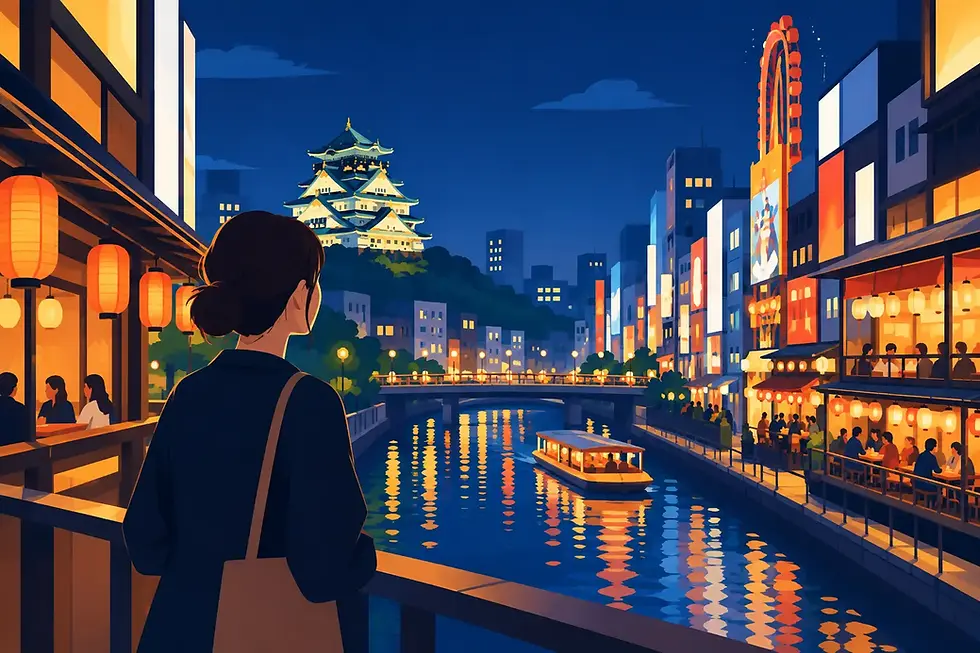
Osaka is widely seen as Japan’s comedy capital, and locals often take pride in quick banter, friendly teasing, and a willingness to play along. That does not mean everyone in Osaka is performing manzai at the grocery store. It does mean humor is a familiar social language here.
Kansai dialect also has a strong comic identity. Its sound, vocabulary, and cadence can signal warmth, directness, or a playful character type to Japanese listeners. When a comedian switches dialects or uses a classic Kansai phrase, native audiences may get an extra layer that subtitles cannot fully carry.
For an English-speaking visitor, the best way to feel that energy is not to study every dialect note on your phone. Go where people are having fun. Listen to friends tease each other. Notice how a good host keeps a group relaxed. Comedy works best when it feels social, not like homework.
English Stand-Up Is a Great Way In
If your goal is a fun night rather than a language lesson, English stand-up lets you enjoy Osaka’s comedy culture without waiting for subtitles. You get jokes you can follow in real time, plus the unpredictable energy of a room filled with travelers, locals, expats, students, and people who simply wanted to laugh after dinner.
At Osaka Comedy Club, the show is in English, so there is no language barrier between you and the punchline. But you are still having a very Osaka night out: live comedy in Namba, a crowd with stories from everywhere, and the easy social buzz that makes a city feel less like a checklist and more like a place you have actually experienced.
You may even notice something familiar. A great comic in any language understands pace, surprise, tension, character, and the pleasure of saying the thing everyone was thinking. The style changes. The basic human need to laugh together does not.
So next time a Japanese joke leaves you half a beat behind, stay with it. Watch the reaction, notice the role each person is playing, and enjoy the fact that comedy is giving you a small window into how people relate to one another. Then find a live show, grab a seat, and let the room do the rest.


Comments